Q1 Non-residential Construction Up 3.1% over Q4 2017
Apr 30, 2018
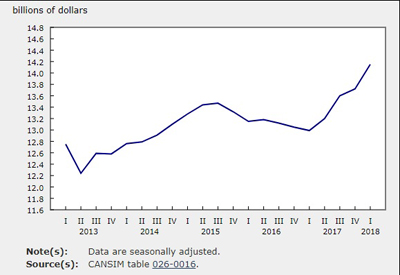
Investment in non-residential building construction totalled $14.1 billion in the first quarter, up 3.1% from the previous quarter. This was the fourth consecutive quarterly rise, leading to a 9.0% year-over-year increase in construction investment. Gains were reported for all components (industrial, commercial and institutional), led by a $193.5 million increase in investment in commercial buildings compared with the previous quarter.Investment in non-residential building construction totalled $14.1 billion in the first quarter, up 3.1% from the previous quarter.
This was the fourth consecutive quarterly rise, leading to a 9.0% year-over-year increase in construction investment. Gains were reported for all components (industrial, commercial and institutional), led by a $193.5 million increase in investment in commercial buildings compared with the previous quarter.Investment was up in nine provinces in the first quarter, with Ontario (+$300.7 million) reporting the largest rise, followed by British Columbia (+$58.3 million) and Quebec (+$47.6 million).Commercial buildings, up $162.7 million (+5.1%), led the Ontario non-residential construction portfolio.
Investment in office buildings (+$96.1 million) and passenger terminal construction (+$58.9 million) were the main drivers behind the increase in the commercial component.Ontario reported lower spending on shopping centres, retail and wholesale stores (-$29.7 million), as well as restaurant buildings (-$23.8 million).Of the 16 census metropolitan areas (CMAs) in Ontario, Toronto (+$154.9 million) posted the largest rise among the 11 that reported increases in commercial spending.All three components contributed to the quarterly increase in British Columbia, with the largest gains reported in the CMAs of Vancouver (+$44.2 million) and Abbotsford (+$10.0 million).
Spending on industrial building construction posted the largest increase (+$22.7 million), the result of additional investment in manufacturing plant construction (+$16.3 million). Spending on institutional (+$19.7 million) and commercial (+$15.9 million) building construction also rose compared with the previous quarter. In Quebec, investment in institutional (+$26.2 million) and commercial (+$25.5 million) building construction contributed to the quarterly increase. The gain for the commercial component was mainly due to spending on the construction of theatre and performing art centres (+$22.2 million) and warehouse buildings (+$21.6 million).
The institutional component was mainly driven by spending on hospitals and health care building construction, up $31.1 million. In Quebec, the CMAs of Montréal and Québec reported the only increases in non-residential spending during the quarter. Investment was up in all the Atlantic provinces, with the largest gains in New Brunswick (+$14.5 million), led by institutional (+$8.7 million) and commercial (+$8.2 million) building construction.
In Nova Scotia, a $10.6 million increase was the result of spending on commercial building construction (+$14.8 million), which offset lower spending on institutional and industrial building construction.Saskatchewan was the lone province to post a quarterly decrease (-$14.1 million).
The institutional component reported the largest decline (-$20.0 million), mainly due to lower spending on hospitals and health care building construction (-$12.6 million) in the quarter, which has steadily declined since the record high of $122.7 million in the third quarter of 2016.Source: Statistics Canada, http://www.statcan.gc.ca/daily-quotidien/180419/dq180419b-eng.htm