New Housing Price Index Up in February
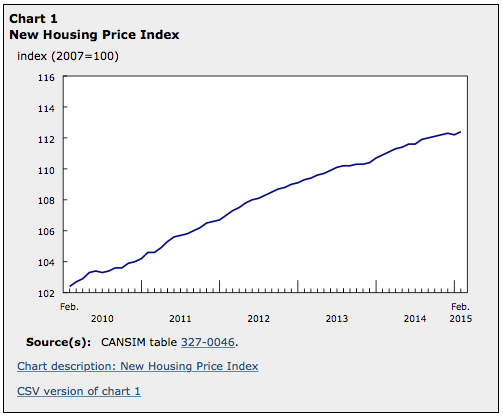
Following a 0.1% decline in January, the New Housing Price Index (NHPI) rose 0.2% in February.The combined metropolitan region of Toronto and Oshawa was the top contributor to the increase, with prices up 0.3% over the previous month. Market conditions and new list prices were the main reasons behind the gain. This was moderated by some builders offering promotional packages to stimulate sales and by lower list prices.
The census metropolitan areas (CMAs) of Halifax and Kitchener-Cambridge-Waterloo recorded the largest price increases in February (both up 0.4%).
The price gain in Halifax, the largest since July 2013, followed three months of no change. Builders in Halifax reported new list prices and higher land development costs as the main reasons for the advance. In Kitchener-Cambridge-Waterloo, builders cited market conditions as the reason for the gain.
New home prices also increased in Montreal (+0.3%) and Edmonton (+0.2%) in February. Builders in both CMAs reported new list prices and higher costs for material and labour as the reasons for the rise. This was the largest increase in Montreal since August 2013.
Prices were unchanged in 9 of the 21 metropolitan areas surveyed.
Source: Statistics Canada, http://www.statcan.gc.ca/daily-quotidien/150409/dq150409b-eng.htm?cmp=mstatcan.