Investment in Building Construction Decreased 0.9% in June
Aug 28, 2019
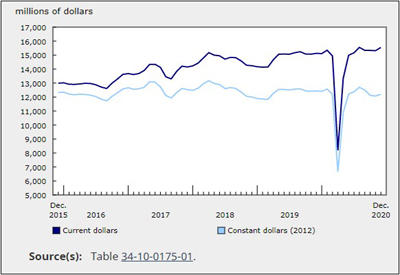
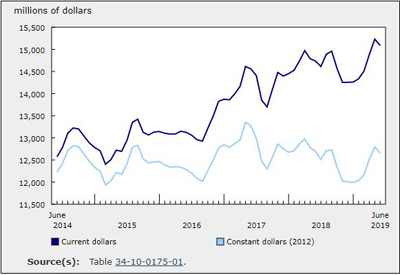
Total investment in building construction decreased 0.9% in June to $15.1 billion, the first decline in eight months. A slight increase in non-residential investment (+1.0% to $4.8 billion) was offset by a decrease in the residential sector (-1.8% to $10.3 billion). On a constant dollar basis (2012=100), investment in building construction decreased 1.1% to $12.7 billion. Despite the monthly decrease, total investment grew 1.6% year over year in the second quarter.
Decline in multi-unit investments
Investment in multi-unit dwellings declined for the first time in eight months, down 4.4% to $5.3 billion, while investment in single-unit construction increased 1.0% to $5.0 billion. The decrease in total residential investment stemmed mainly from declines in British Columbia (-$174.1 million) and Manitoba (-$54.0 million).
Non-residential investment
Non-residential investment increased in seven provinces, led by British Columbia (+$27.4 million). This growth more than offset the declines in Newfoundland and Labrador, Prince Edward Island and New Brunswick.
All three components in the non-residential sector posted gains. The institutional component had the largest increase (+1.4% to $1.1 billion), which was due to projects such as the new Calgary Cancer Centre. The commercial component advanced 0.9% to $2.8 billion, while investment in the industrial component increased 0.7% to $911.1 million.
Second quarter 2019
Total investment in building construction grew 1.6% (+$710.7 million) in the second quarter, compared with the same quarter a year earlier. The gain was driven by multi-dwelling investments in British Columbia (+36.6%) and Ontario (+20.6%). By contrast, investment in single-unit dwellings decreased 9.9%, compared with the second quarter of 2018.
For non-residential investments, the institutional component was the only component to post a decrease (-6.9%), with the largest declines observed in Alberta (-21.3%) and Ontario (-13.0%).
On an unadjusted basis, quarterly investment in new non-residential construction remained strong—increasing 9.4% year over year to $6.5 billion. This increase reflects gains in the commercial component (+$517.5 million)
Investment in new residential construction was down 4.3%, compared with the second quarter of 2018, to $13.3 billion, as a result of decreases in single-family homes (-22.1%) and semi-detached homes (-14.6%). However, this was moderated by investment gains in row homes (+14.0%) and apartments (+11.5%).
Source: Statistics Canada, www150.statcan.gc.ca/n1/daily-quotidien/190821/dq190821b-eng.htm?CMP=mstatcan