Canada-U.S. Electricity Trade Increases
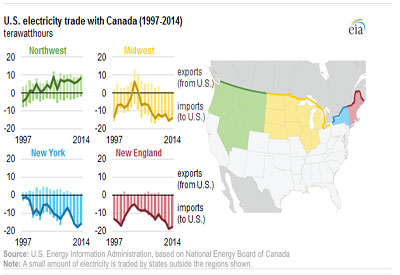
Canadian electricity trade with the United States is increasing, providing more economic and reliability benefits to both countries. Although the amount of electricity exported from Canada is a small part of the overall U.S. power supply, the transmission connections linking Canada and the United States are an important component of the electricity markets in northern U.S. states.
Overall, Canada is a net exporter of electricity to the United States, and most of its power needs are met by hydroelectricity. Large hydroelectric projects in British Columbia, Manitoba, Quebec, and Newfoundland and Labrador have significantly increased the country’s generation capacity. On a net basis, Canada exports electricity mainly to New England, New York, and the Midwest states, while the United States exports electricity primarily from the Pacific Northwest states to British Columbia.
Electricity trade between Canada and the United States benefits both countries. Customers in western Canada and in the U.S. Northeast can access low-cost hydropower resources from the other side of the border. Also, the Northeast Power Coordinating Council (NPCC), the Midwest Reliability Organization (MRO), and the Western Electricity Coordinating Council (WECC) ensure that power flowing across U.S.-Canada transmission lines helps maintain the stability of the North American eastern and western power grids.
There are currently more than 30 power transmission linkages between the two countries. During 2014, 60 companies in Canada exported 58.4 terawatthours (TWh) of electricity into the United States, making up 10% of Canadian electricity generation and 1.6% of U.S. electricity retail sales. The largest exporters were Hydro-Québec (16.4 TWh) and the Manitoba Hydro-Electric Board (8.6 TWh).
New England and New York accounted for 60% of the total electricity imported into the United States in 2014, and these imports represent 12%-16% of the region’s retail sales of electricity. New England imports its electricity primarily from Quebec. New York imports electricity from the hydroelectric resources in Quebec and Ontario, often on a flexible schedule as needed. New England’s power generation sources have been shifting to natural gas in recent years, but the region also has been importing more of the hydroelectricity from Canada. Minnesota and North Dakota imported 12% of their electricity from Canada in 2014.
The Pacific Northwest is a net electricity exporter to Canada because it has hydroelectric capacity that generates large amounts of electricity in excess of the region’s need during high-water periods. This electricity helps Canada meet periods of peak demand.
Recent and proposed transmission projects have the potential to increase the amount of trade across the border. The Montana-Alberta Tie Line, completed in 2013, is a 230 kilovolt (kV) line that allows for bidirectional flow of power primarily for new wind power generating units on both sides of the border. The Great Northern Transmission line is a proposed 500 kV project connecting Minnesota Power with Manitoba Hydro, which is intended to support development of wind resources in the upper Midwest. Developers hope to relieve transmission congestion in the New York City area by sending hydropower directly from Quebec via the proposed Champlain Hudson Power Express transmission project, which could bring up to 1,000 megawatts of additional power into the city.
Source: U.S. Energy Information Administration, http://www.eia.gov/todayinenergy/detail.cfm?id=21992